
India's biggest car maker Maruti Suzuki said on Tuesday that its vehicle production in September will tumble by 60 per cent due to chip shortage. The company, which had earlier cut down production at its Gujarat plant, said the chip shortage will hit production in Gurugram and Manesar plants, effectively forcing the automaker to cut production by 60 per cent. Owing to a supply constraint of electronic components due to semiconductor shortage, the company is expecting an adverse impact on vehicle production in September in both Haryana and its contract manufacturing company, Suzuki Motor Gujarat Pvt Ltd. (SMG) in Gujarat.

The ongoing key reforms such as sops for manufacturing, easier labour laws, wooing FDI inflows and privatisation will help improve productivity and support long-term growth at 7.5-8 per cent levels, which if played out well, can help India contribute 15 per cent of global GDP growth by FY2026, says a report. According to a report pencilled by the India economist at UBS Securities, Tanvee Gupta Jain, the country has the lowest manufacturing costs among peers, even though China retains significant ecosystem advantages and despite that India and Vietnam appear most likely to benefit from a shift out of China.

The steep rise in prices of key components, coupled with a ban on the import of finished sets, is expected to hit prominent Chinese brands, such as OnePlus, Xiaomi, TCL, and Realme.

Most players are looking to invest anywhere between $500 million and $1 billion in new ventures in the next couple of years, said experts on this segment.

With consumers staying indoors and e-commerce firms extending their reach to a larger number of pin codes, these giants have snatched a larger share from the offline traders this season.

The shortage of semiconductors globally is expected to persist through 2021 and recover to normal levels by the second quarter of 2022, which will constrain the production of many electronic equipment types this year, according to research firm Gartner. Semiconductors play a crucial role in everything, right from computers to appliances, communication devices, transportation systems to critical infrastructure. The breakout of the COVID-19 pandemic had temporarily disrupted semiconductor shipments.

Mobile device maker Realme has overtaken South Korean giant Samsung to grab the second spot in the branded smartphone market, with 18 per cent volume share in October this year, revealed Counterpoint Research. Its rival Samsung ended October with 16 per cent share. Xiaomi (including its brand POCO) was at 20 per cent; Vivo at 13 per cent. The ascent brings Realme closer to its ambition to reach the No. 1 berth by 2022 when it hopes to sell over 40 million smartphones annually.

'As long as businesses do not consider cyber recovery an integral part of their enterprise IT, they remain greatly vulnerable.'

While the most obvious beneficiary of this roll-out will be manufacturers of FASTags, or the Radio Frequency Identification chips, a PwC report says implementation of a pan-India electronic toll collection system on national highways may help save approximately Rs 87,000 crore annually.

The move, however, is unlikely to prompt its rivals in India - Chinese manufacturers like Oppo, Vivo, and Xiaomi - to do the same.

"The DAC accorded approval for procurement of equipment worth over Rs 5,100 crore from indigenous sources. These include sophisticated Electronic Warfare Systems for the Army designed by DRDO and manufactured locally by the Indian industry," the defence ministry said.

The group is among the 40 largest defaulters identified by the Reserve Bank's first list for insolvency in late 2016.

Categories such as lifestyle, food and electronics accounted for over 1,350 sellers across the country last year.

Chinese mobile brands are deeply entrenched in the Indian market. A move to bar them may send a bold diplomatic message. But its cost for the local industry is anybody's guess. In the event that Chinese brands face curbs, two handset makers - Samsung and Apple - squarely stand to gain.

Top companies across sectors -- automobile maker Maruti Suzuki, consumer electronics giant Samsung to IT giant Infosys -- have reopened factories and offices as India took its first steps towards resuming economic activity after weeks under a near-total coronavirus lockdown.
RJio's LYF, Videocon and other smartphone makers to also get notices

'We continue to believe that the global economy will narrowly avoid a recession, despite expecting the US, Canada, and most of Europe to fall into recession at some point over the next year or so.'

India remains an attractive destination for foreign direct investments (FDI) on account of healthy prospects of economic growth and its skilled workforce, according to a survey by Deloitte. A large proportion of international business leaders remain confident in India's short- and long-term prospects and are readying plans to make additional and first-time investments in the country, it said on Tuesday. "The survey, which questioned 1,200 business leaders of multinational corporations in the US, UK, Japan and Singapore, found that India remains an attractive destination for investments, scoring highly for its skilled workforce and prospects for economic growth," the survey - India's FDI Opportunity - said.

The soaring prices of metals like lithium, nickel and cobalt, which are the primary constituents of the cell, as well as supply chain bottlenecks, are also pushing up the cost of batteries

As per use-based classification, primary good registered a growth of 7.4 per cent, intermediate goods 22.4 per cent, and infrastructure/construction goods 0.1 per cent in February 2020 as against the same period a year ago.

Tata Motors, India's third largest passenger vehicle maker, took pole position in the competitive sport utility vehicle (SUV) market in October, reveals the data from industry sources. Riding high on the Punch - the sub-compact SUV offering launched on October 18 - the Tata group flagship sold a record 23,381 units in October, higher than 20,022 units sold by archrival Mahindra & Mahindra, 18,538 units sold by Hyundai Motor India, and 15,931 units sold by Kia Motors India. Utility vehicles - that include SUVs and multipurpose vehicles - accounted for almost one in every two passenger vehicles sold in India in the first seven months of the current financial year, according to the Society of Indian Automobile Manufacturers.

After 2014, our growth has been average of around 5%. If this continues, we will remain here like Egypt, Brazil, South Africa and Bangladesh, points out Aakar Patel.

The 1,600-member crew and a slew of civilian workers were working like busy bees on Friday preparing the majestic warship IAC Vikrant for its commissioning on September 2.

The most important positive of India's stealth bull market is earnings growth across different sectors, explains Debashis Basu.

While traditional automakers in India are reeling under a global shortage of semiconductors, the country's electric vehicle (EV) makers, too, are now facing a shortage of lithium-ion batteries, a key raw material. The soaring prices of metals like lithium, nickel and cobalt, which are the primary constituents of the cell, as well as supply chain bottlenecks, are also pushing up the cost of batteries. Battery manufacturers say that prices have been increasing every quarter since the beginning of 2021.

Apple Inc is commencing assembly of its iPhone 12 model in the country, a move that is expected to help the US tech giant further consolidate its position in the burgeoning smartphone market in India. Apple has partnered with third-party manufacturers like Foxconn and Wistron to make some of its phones in India. These include iPhone SE, iPhone 10R and iPhone 11.

With increase in range and payload capability, Madhavan said the new variant will be much superior than Tejas Mark-IA, 73 of which are being procured by the Indian Air Force from the HAL under a Rs 48,000 crore deal that was approved by the government on January 13.
Shortages of chips will impact the car market

The Russian-Ukraine war can hit the global supply chains that are already constrained due to the pandemic and the worst impact will be on ongoing chip shortage because the warring nations brutally control supplies of key raw materials that go into making semiconductors, warns a report. Since Russia controls as much as 44 per cent of global palladium suppplies, Ukraine produces a significant 70 per cent of the global supply of neon -- the two key raw materials that go into making chips. The markets can expect the global chip shortage, that began with the pandemic, to worsen if the military conflict lingers on, says a Moody's Analytics report on Friday.

With versatile imaging and unmatched gaming experience, the Redmi Note 8 Pro has the makings of an all-round smartphone, says Khalid Anzar.

The Union government on Tuesday said it has issued 202 notices to e-commerce players for incorrect declaration of 'country of origin' on products on their platforms in the last one year. The maximum number of such violations were found with respect to electronic appliances, followed by clothing and home products. Out of 217 notices, 202 notices were issued for violations relating to 'country of origin' norm.


With supply of mobile chipsets running dry, manufacturers here are left with no option but to hike prices once again, making it the fourth round of increase in 2020.

The VL-SRSAM, which DRDO developed for the Indian Navy, was fired from a warship at a high-speed aerial target mimicking incoming enemy aircraft.

According to the order, all factories producing essential goods and services will remain operational at full capacity.

The Tejas Mark 1A outperforms the Sino-Pakistan JF-17 Thunder in avionics and weaponry, but the finance ministry's tax burden makes the Indian LCA costlier and hurts it in the export market.
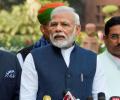
The PM said that the Union Budget will accelerate the economic growth, financially empower every citizen and strengthen the foundation of the economy in the new decade.

Tamil Nadu Chief Minister K Palaniswami on Tuesday launched new industrial and MSME policies aimed at providing further impetus to industrial growth by attracting more investments and also offering sops for development in the industrially backward districts.

The country's largest carmaker Maruti Suzuki India on Thursday launched a new version of its multi-purpose vehicle XL6 as it gears up to bring a slew of new products this fiscal and take the challenges of prevailing uncertainties head-on. The new XL6 is powered by a 1.5-litre petrol engine with a peak power of 75.8 kW. It is available in manual and automatic transmission options, priced between Rs 11.29 lakh and Rs 14.55 lakh (ex-showroom). Speaking at the launch, newly appointed Maruti Suzuki India managing director and CEO Hisashi Takeuchi said, "With the uncertainties prevailing today, the business realities are continuously evolving.

Infra major's entry could queer the pitch for Jaypee and Hindustan Semiconductor.
